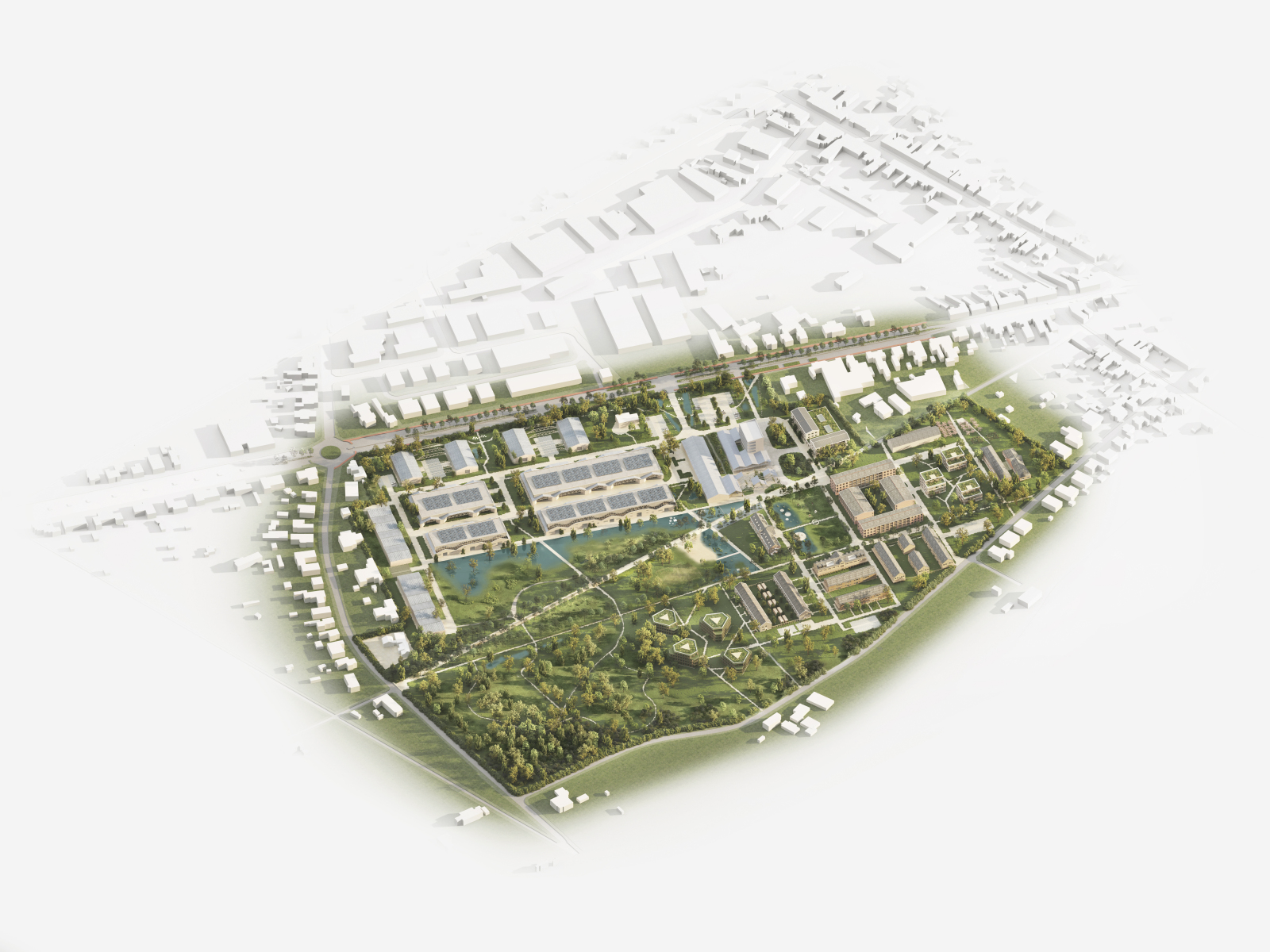
Kwartier 51 transforms a long-closed military enclave on the edge of Sijsele into an open and future-oriented district where living, working, and leisure reinforce one another.
The vision builds on the site’s existing qualities and its layered context. Historic landscape structures, the orthogonal layout of the former barracks, the elongated sightlines, and the sober, functional use of materials form the foundation of the design. The strength and identity of the place do not lie in individual objects, but in the ensemble value of the whole. This coherence is not only respected, but actively employed as the framework for the new district.
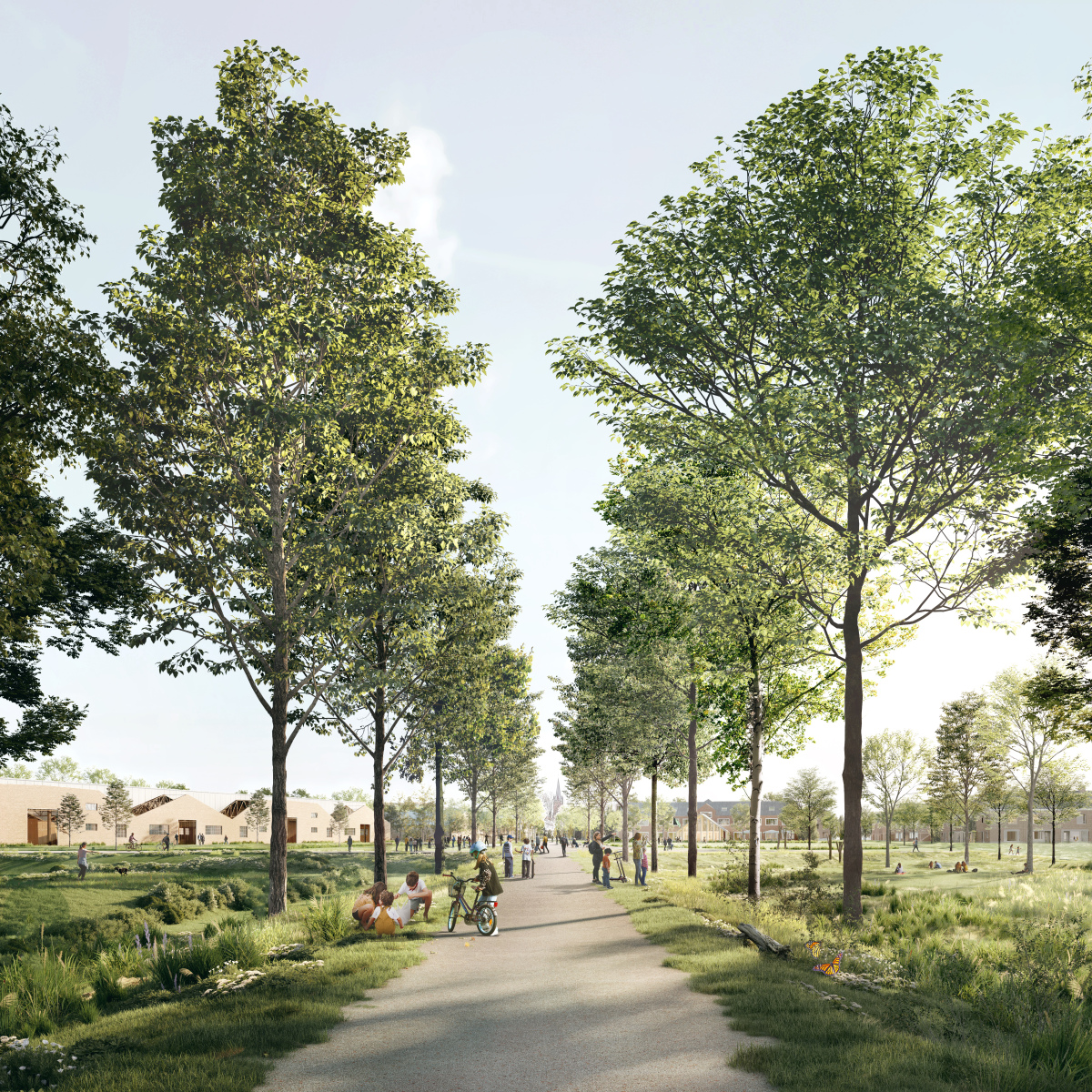
As a result, the former Sergeant Baron Gillès de Pélichykazerne remains clearly legible. The existing structure is not treated as a constraint, but as a spatial framework within which new programs can take root. Heritage is not preserved for its own sake, but mobilized as a driver for development. The central axis is retained as a green backbone, linking the district to the village center and the Ryckevelde forest.
The location—between village core and landscape—defines the character of the plan. Public space, nature, and program are interwoven into a coherent whole, where a park with water features, newly planted woodland, play and sports areas, and a fine-grained network of walking and cycling paths form the connection between neighborhood, village, and forest.
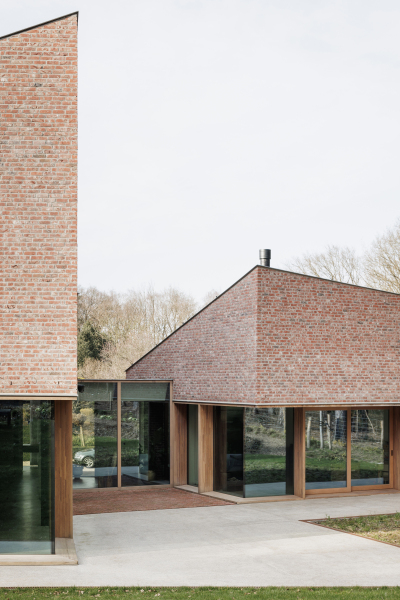
The program goes beyond conventional housing. A total of 225 residential units are developed for a wide range of households, combined with small-scale commercial activities, public facilities, and neighborhood-oriented hospitality. Existing buildings are given new life through adaptive reuse, while new volumes are conceived with flexibility, allowing them to respond to changing needs over time. Multifunctionality—from shared spaces to ateliers and care-related uses—is not an exception, but a structural principle.
Sustainability is an integral part of the design. New buildings prioritize circular material use, shared energy solutions, rainwater management, and soft mobility. The reuse of existing structures is not only an ecological choice, but also a way to preserve character and authenticity. In this way, the district develops into a robust and adaptive living environment, rooted in the past and prepared for the future.